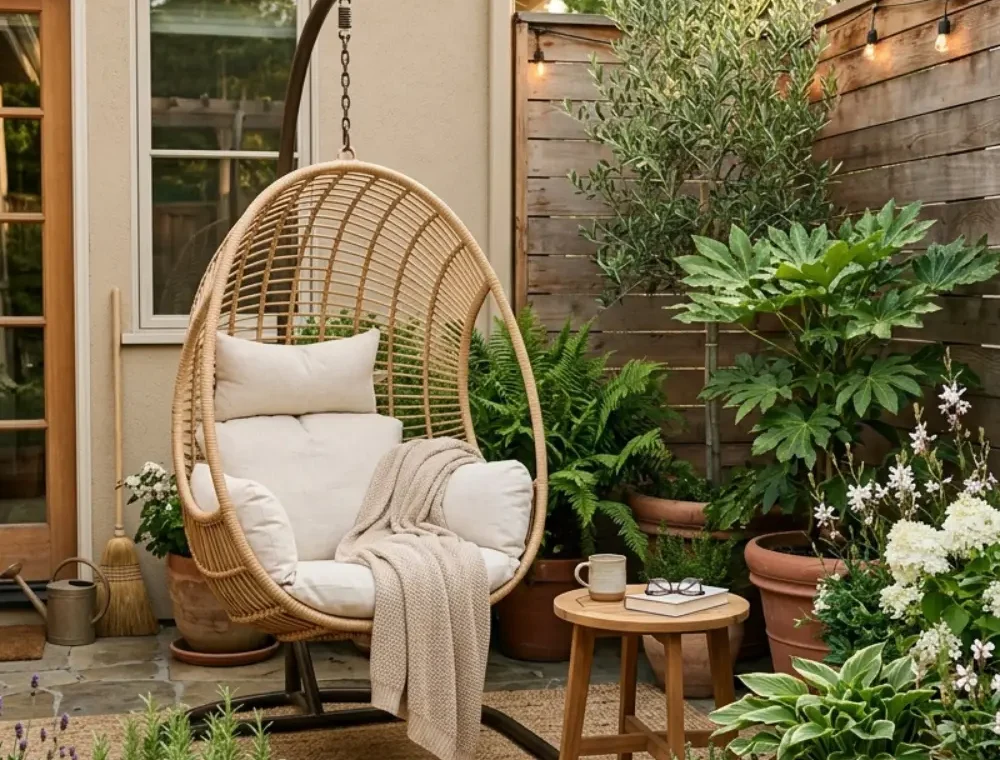
Patio garden ideas with hanging chair can make a patio feel inviting without requiring much else. Place a hanging chair in a quiet corner, surround it with a few healthy plants, and that empty concrete space can quickly become a cozy spot for morning coffee, reading, or relaxing outside after dinner.
The chair should not be treated as the last decorative accessory, though. It takes up more usable space than a normal chair because you need room to get in, move a little, and walk around it. Plants need their own space too. A beautiful patio garden can become annoying quickly if every leaf brushes your shoulder or the chair keeps bumping a planter.
My approach is to position the hanging chair first, then build the garden around it. That usually gives a more believable result than filling the patio with pots and trying to squeeze a chair into whatever gap remains.
These patio garden ideas with a hanging chair include sunny and shaded layouts, renter-friendly options, privacy planting, herb gardens, lighting, rugs, small patios, and simple ways to keep the finished space lush without making it crowded.
What Makes a Hanging-Chair Patio Garden Work?
The best setup has three layers.
The hanging chair creates the main sitting zone. Medium and tall plants shape the garden around it. Smaller details such as an outdoor rug, side table, lantern, or string lights make the area comfortable after the plants are in place.
The part I would decide first is whether the chair will hang from a structure or sit on its own stand.
A freestanding chair is much easier when you rent, do not know what is inside the patio ceiling, or want to move the layout later. A ceiling- or beam-hung chair can look lighter, but the mounting point has to be suitable for the specific product and the expected moving load.
Do not guess from appearance. A finished ceiling, decorative pergola board, or exposed member is not automatically a safe hanging point. Follow the chair manufacturer’s instructions and have the structure checked by a qualified professional when you are unsure.
After that, think about light. A plant that looks perfect in a Pinterest image may struggle on your patio if the space gets four hours less sun.
For U.S. readers choosing perennial patio plants, the USDA Plant Hardiness Zone Map is a useful starting point for winter hardiness. Sun exposure, summer heat, wind, container size, and watering still matter too.
Before You Buy Anything, Measure the Patio
Measure the full usable area, including doors, steps, railings, grill zones, outdoor faucets, and any path people already use.
Then measure the hanging chair itself. Do not rely only on the seat width. Look at the stand footprint if it is freestanding, the overall chair width and depth, and the movement area specified by the manufacturer.
I like to mark the proposed chair zone with painter’s tape or a few empty boxes before buying planters. Sit in a normal chair inside that area and walk around it. This simple test can reveal that a planter you thought would fit actually blocks the door.
For small patios, protecting the walkway matters more than creating perfect symmetry.
Costs below are rough U.S. planning ranges, not product quotes. Outdoor furniture, plants, pottery, local labor, shipping, and seasonal sales can change them a lot.
1. Start With the Hanging Chair, Not the Plants
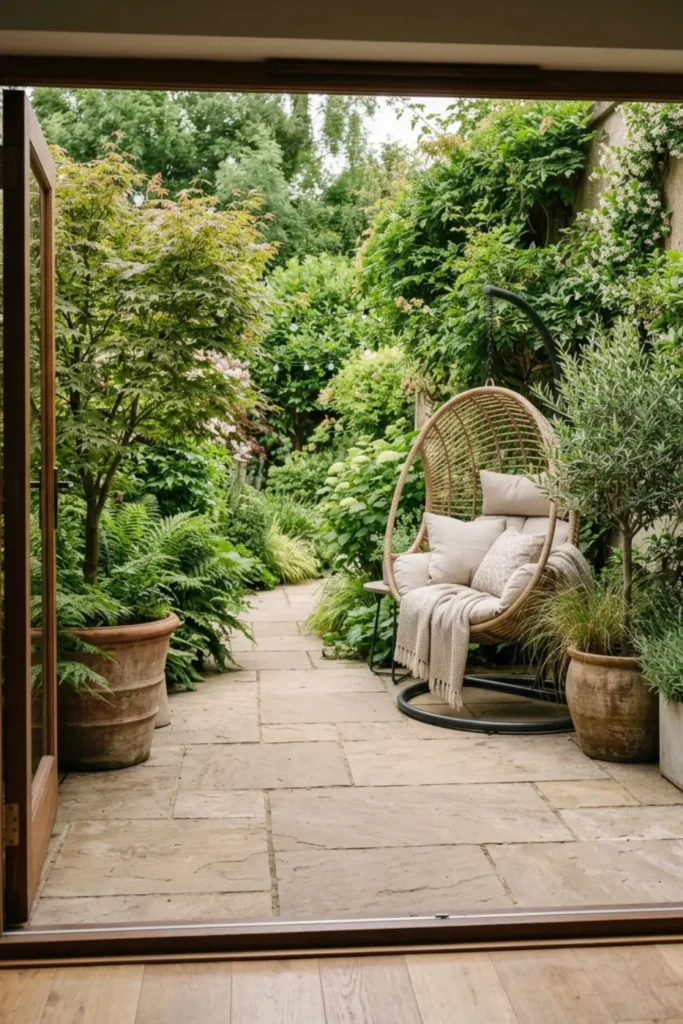
Choose the chair position before building the garden.
A corner often works because the chair can become a visual destination without dividing the center of the patio. Keep the door and main walking path clear, and avoid placing the chair where people have to squeeze around it every time they step outside.
If you are using a chair with a stand, mark the entire base on the floor. Some egg-chair stands are much wider than they look in product photos.
Once the position feels comfortable, add the largest planters first. I would rather use three well-placed containers around the chair than ten small pots scattered across the floor.
Planning cost: roughly $180–$700 for many retail hanging chairs or egg chairs, with materials and construction varying widely.
2. Use a Freestanding Hanging Chair for a Renter-Friendly Garden
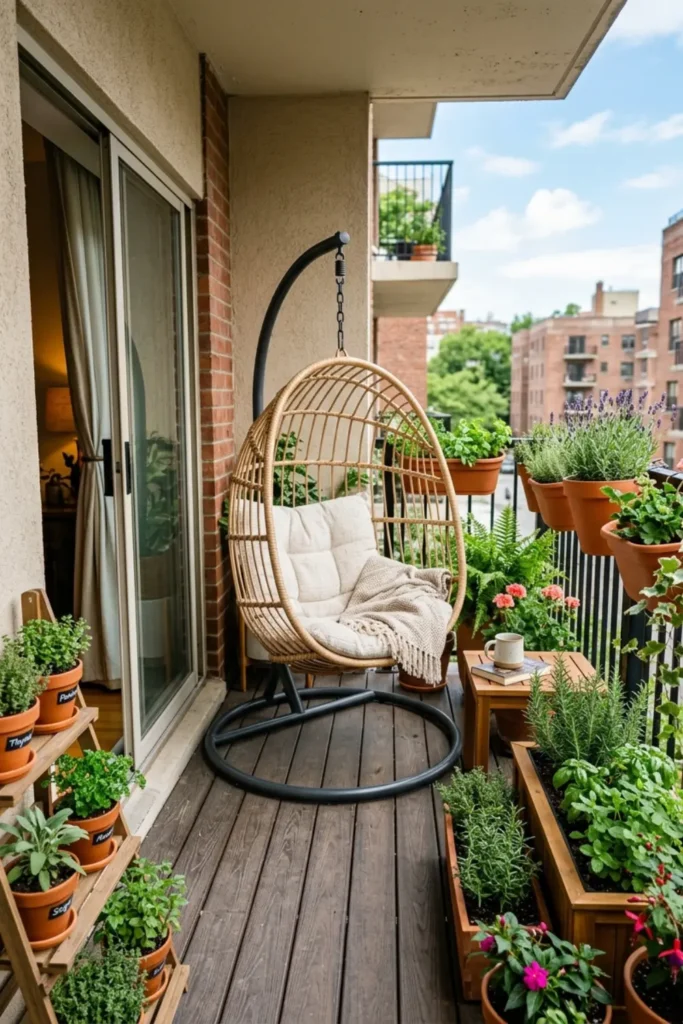
A freestanding hanging chair is my first choice when drilling is not possible or the structure above is unknown.
You still get the suspended look, but the chair moves with you and the garden can be rearranged without patching holes overhead.
The tradeoff is floor space. The stand needs a stable, level surface and can occupy more room than the hanging seat itself.
On a compact patio, look at the stand footprint, not just the chair dimensions. A slim chair on a very wide curved frame may be harder to place than a slightly larger seat on a compact base.
Keep planters outside the moving area and do not use a plant pot as a stop to limit the chair’s motion.
If your outdoor space is very small, you may also find useful layout ideas in 15 Amazing Small Apartment Balcony Ideas That Feel Like a Vacation.
3. Hang the Chair Under a Covered Patio or Pergola
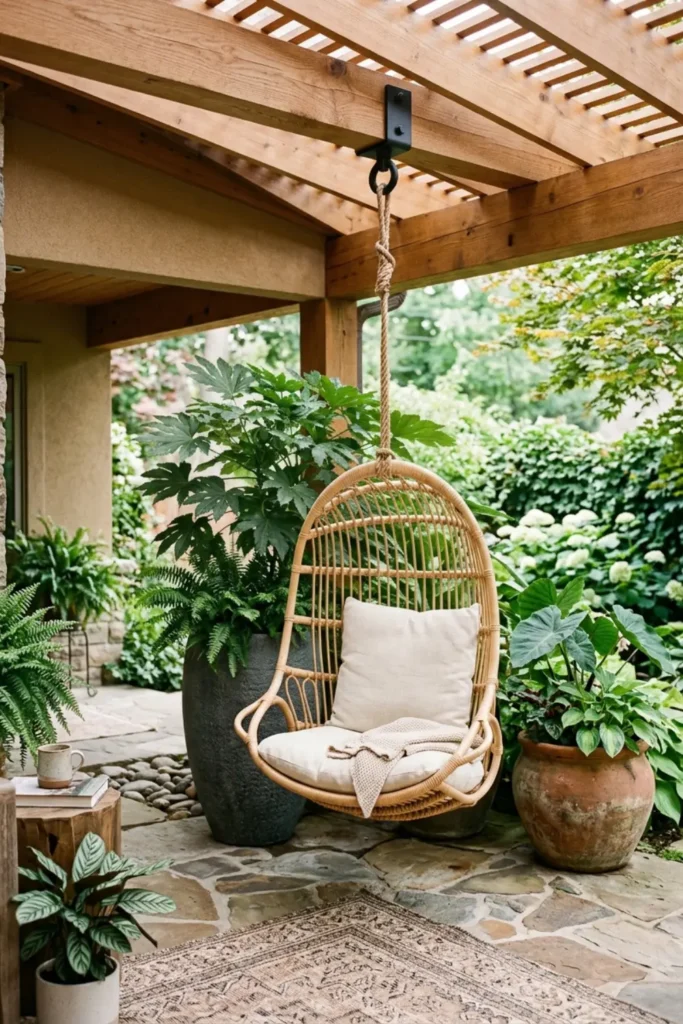
A covered patio can make a hanging chair feel built into the garden, especially when the roof line frames the seat.
This is also a good place for plants that prefer some protection from intense afternoon sun.
The structural part is where I would be careful. A decorative slat, ceiling finish, or pergola component should never be assumed to carry a suspended chair. Use only mounting locations and hardware appropriate for the product and structure.
If a builder, contractor, or other qualified professional needs to verify the attachment point, that is money well spent. A moving person creates a different demand from a hanging planter or light fixture.
Visually, keep the area above the seat fairly simple. One hanging chair plus multiple hanging baskets, string lights, vines, and lanterns can become messy around head height.
4. Frame the Chair With Two Tall Planters
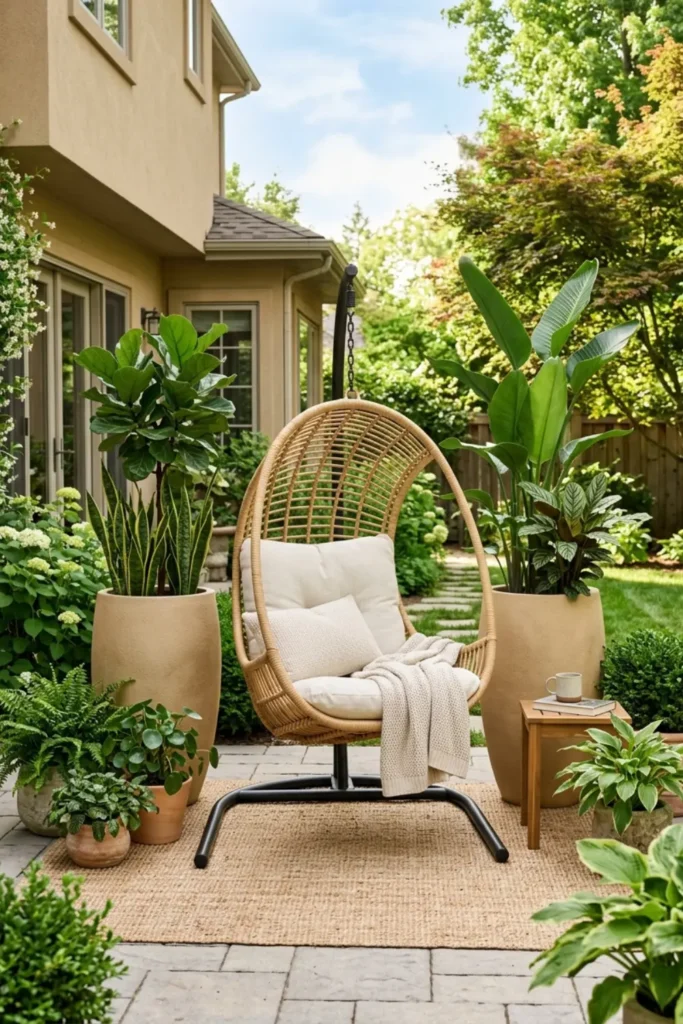
Two taller planters can make the chair feel like it belongs in a garden instead of sitting alone on a patio.
Place them slightly behind or beside the chair, not directly in the movement path. The goal is to frame the seat while keeping leaves and pots away from normal use.
Good plant choices depend on your climate and light. Ornamental grasses, compact shrubs, small palms in suitable climates, upright foliage plants, and narrow conifers can all create height.
For a balanced look, the two planters do not have to match exactly. I prefer similar pot colors with plants of slightly different shapes.
Large containers also dry differently from small pots, so check the soil rather than watering every container on the same schedule.
Planning cost: about $80–$300 for two substantial planters before plants and soil, depending on material.
5. Build a Layered Container Garden Around the Chair
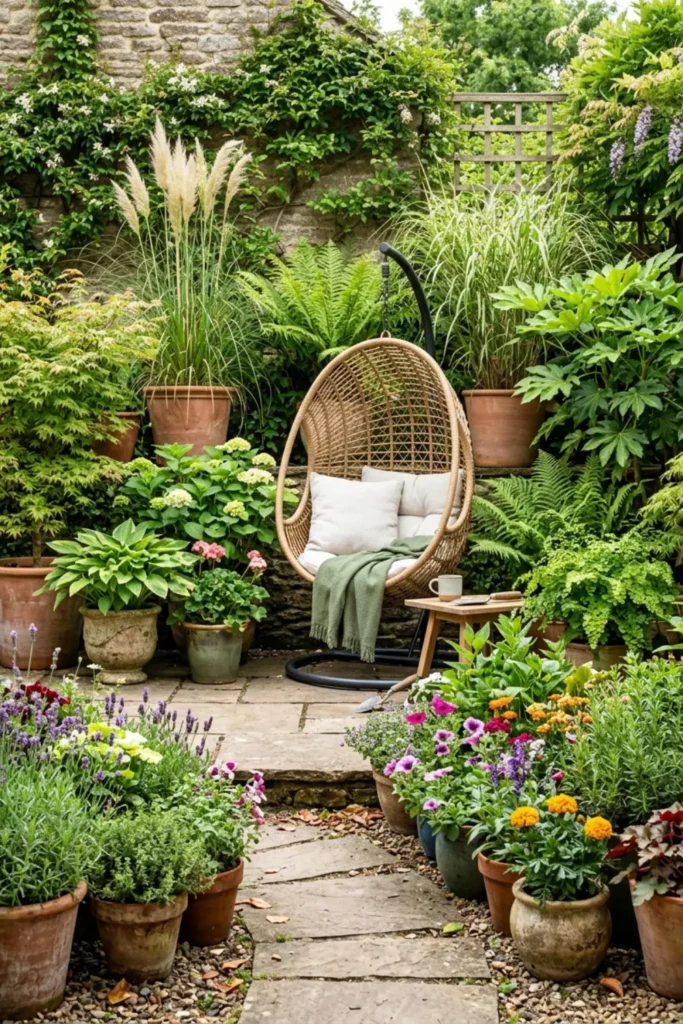
A patio feels more like a garden when plants sit at different heights.
Use one or two tall plants, several medium containers, and a small group of low flowers or herbs. This creates depth without needing a huge number of pots.
I would keep the tallest plants toward the edge or back of the patio. Medium plants can sit closer to the chair, while small pots work near a side table or along a sunny border.
Avoid making a complete ring around the seat. Leave one obvious open side so getting into the chair feels natural.
Container plants may need more frequent watering than in-ground plants, particularly in heat. University of Minnesota Extension notes that container size and temperature can make watering necessary even more than once a day in some conditions. Their container watering guide is a useful reference.
6. Add a Trellis Behind the Hanging Chair
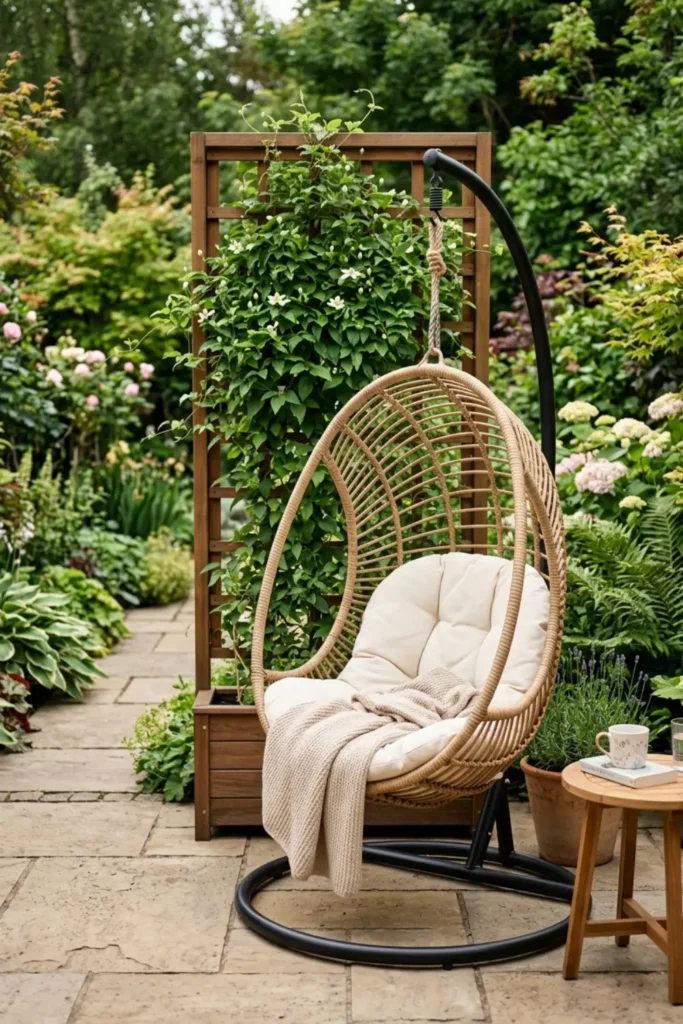
A slim trellis can give a plain patio wall height and greenery without covering the floor in pots.
This works particularly well behind a freestanding chair, where the chair and trellis can read as one garden feature.
Leave enough distance so vines do not grow through the chair frame or catch on the stand. Plants change size during the season, so plan for their mature growth rather than the small nursery pot.
Use climbers suited to your climate, sun level, and support. Some vines become heavy and vigorous, while others stay much easier to manage.
For renters, a freestanding trellis planter is often simpler than fastening a grid to the wall.
I would also avoid training thorny plants directly behind a seat. A patio should still be comfortable when the garden is fully grown.
7. Let Trailing Plants Soften One Side
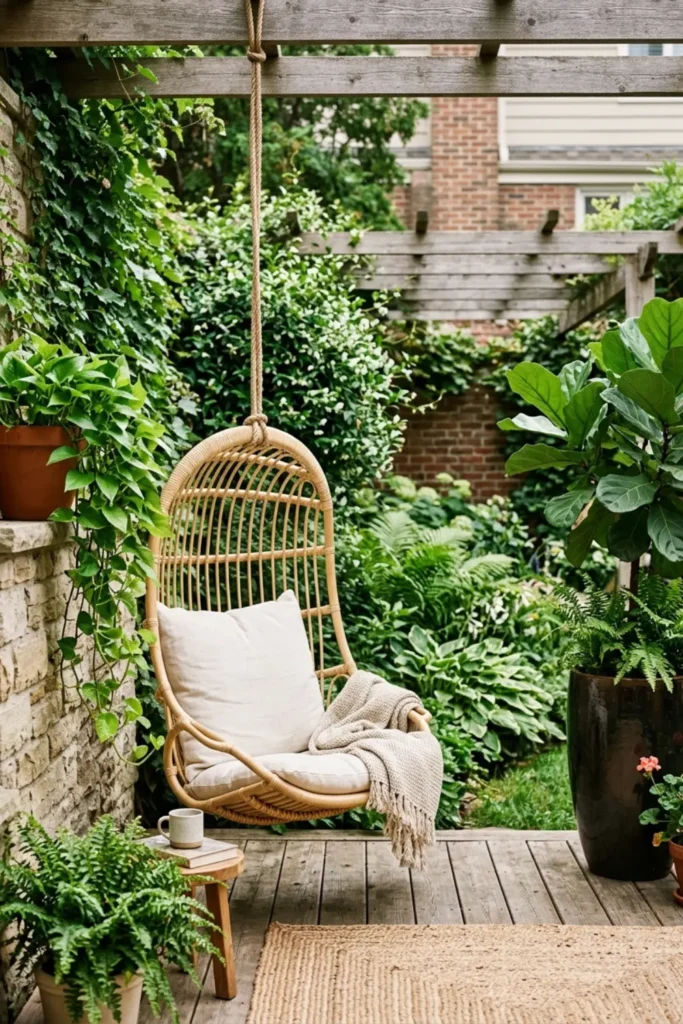
Trailing plants add the loose, relaxed look people usually want around a hanging chair.
Instead of placing them directly above the seat, I prefer using a raised planter, wall shelf, or hanging basket off to one side. The foliage can spill downward without hanging into the chair’s path.
This also makes watering easier. Nobody wants water, soil, or dead leaves dropping onto the cushion.
If your patio is exposed to wind, hanging baskets may dry faster and move more than expected. University of Minnesota Extension specifically notes that hanging baskets can require frequent watering and that windy locations increase drying.
One trailing plant is often enough to soften a hard corner. Three different vines crossing each other usually look untidy by midsummer.
8. Make a Green Privacy Corner
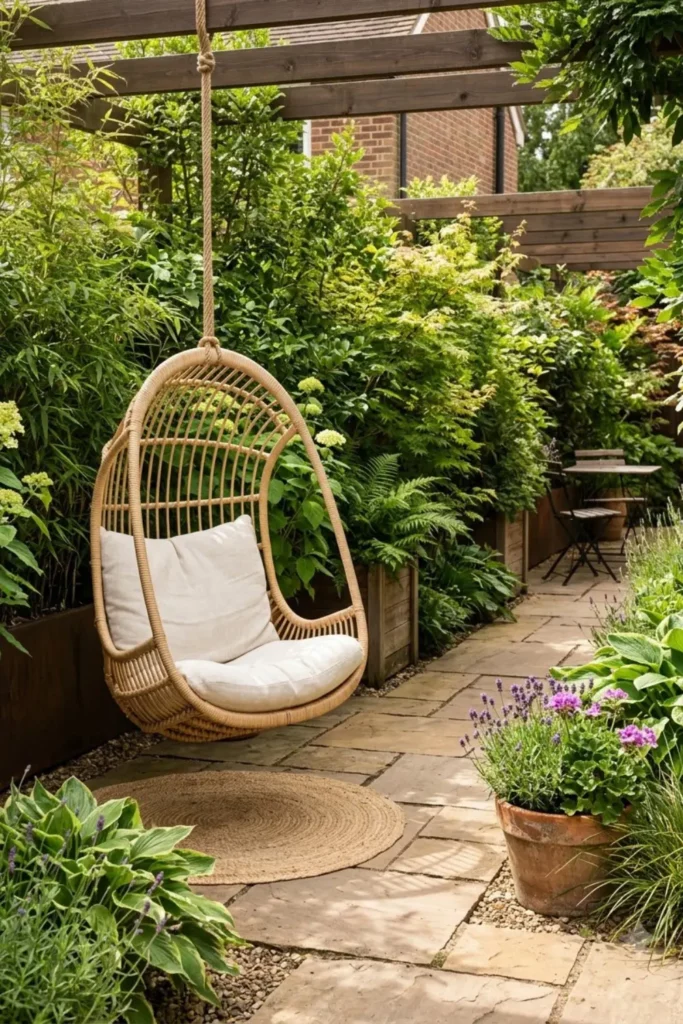
A hanging chair feels more relaxing when it is not facing directly into a neighboring window or busy walkway.
Use taller planters along one edge to create partial privacy while keeping enough openness for air and light.
Bamboo-looking screening plants, narrow ornamental grasses, evergreen shrubs, or tall tropical foliage can work depending on climate. If using true bamboo, understand the growth habit and keep it appropriately contained.
On apartment patios, check building or HOA rules before installing screens, attaching anything to railings, or adding very heavy planters.
I would not aim for a solid green wall unless privacy is really poor. A staggered arrangement that blocks the direct sightline often feels lighter and lets more daylight reach the plants.
The same idea works on balconies; Small Balcony Makeover With Plants: 19 Brilliant Ideas has more plant-first small-space arrangements.
9. Create a Small Herb Garden Beside the Chair
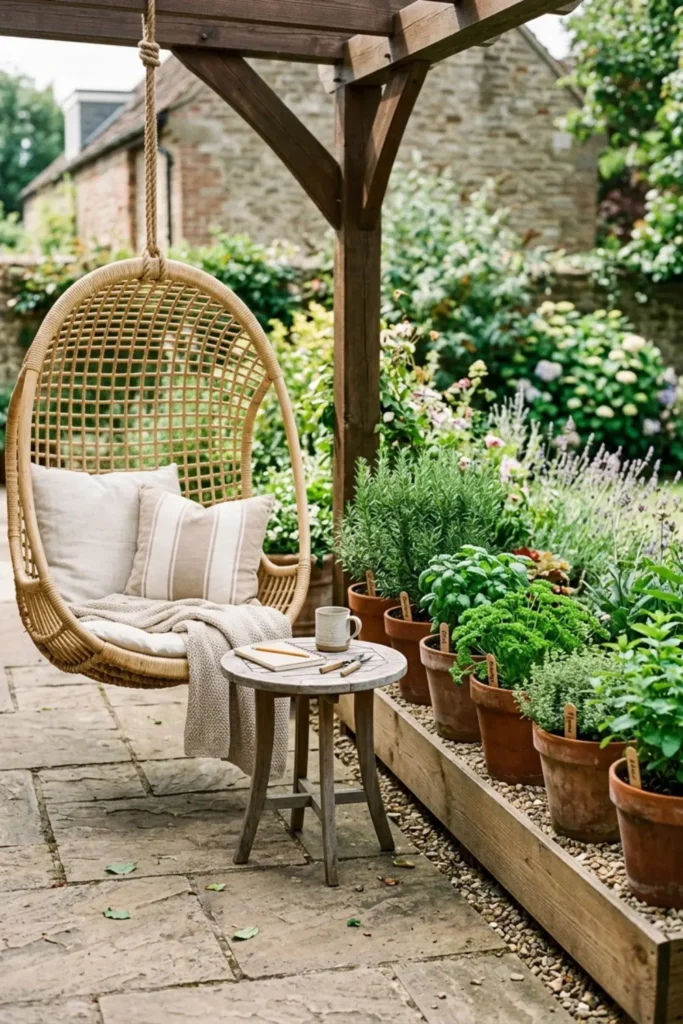
A patio garden becomes more useful when some of it can be harvested.
Place a narrow herb stand, rail-style planter where permitted, or a few medium pots near the edge of the seating zone. Basil, parsley, thyme, mint, rosemary, dill, and chives are common container choices, but each has different light and moisture needs.
Mint is one I would keep in its own pot because it can spread strongly when planted with other herbs.
Do not choose herbs only because they look pretty together. Put sun-loving herbs where they actually receive enough sun and use appropriate pot depth and drainage.
Drainage holes matter. Standing water in a decorative pot can cause problems for many container plants.
If you cook outdoors, keep the herb area close enough to reach without placing pots beside the grill or another heat source.
10. Make a Sunny Mediterranean-Style Patio Garden
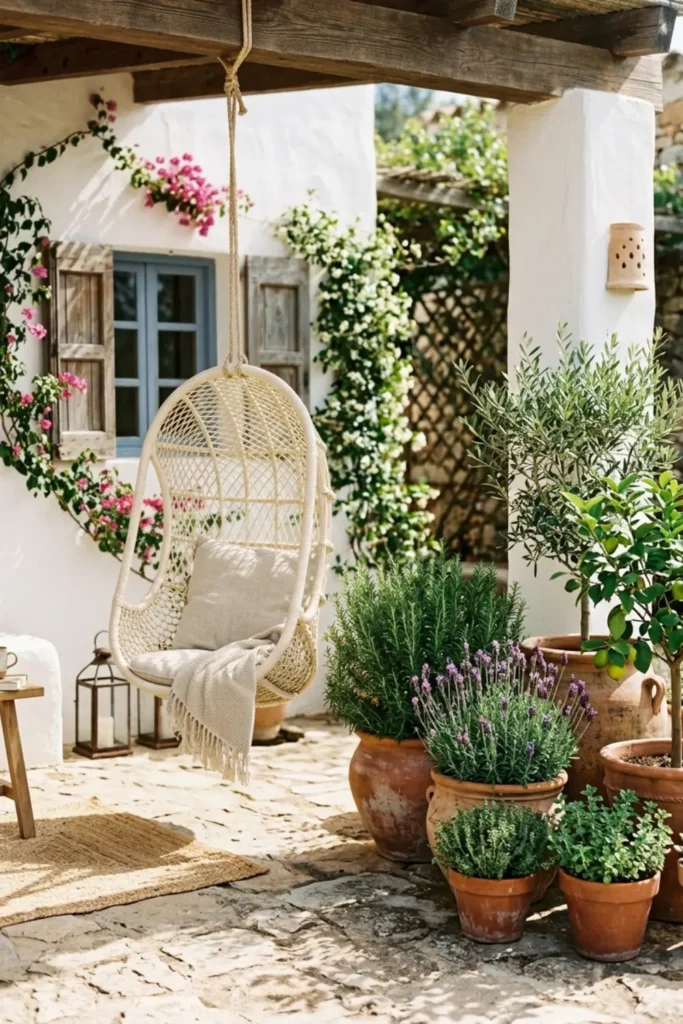
For a hot, sunny patio, a restrained Mediterranean look can work beautifully with a hanging chair.
Use terracotta, warm stone colors, olive-green foliage, herbs, and drought-tolerant plants suited to your local climate.
Lavender, rosemary, thyme, geraniums, small citrus in appropriate climates, and silvery foliage are common inspiration points, but local hardiness and summer conditions should decide what you buy.
Group the pots rather than spacing every container evenly around the patio.
A natural rope, woven-look, or warm beige hanging chair fits this palette without demanding another strong color.
The mistake I would avoid is assuming “Mediterranean-looking” means no watering. Plants in containers often dry much faster than the same plants in the ground.
11. Turn a Shaded Patio Into a Foliage Garden
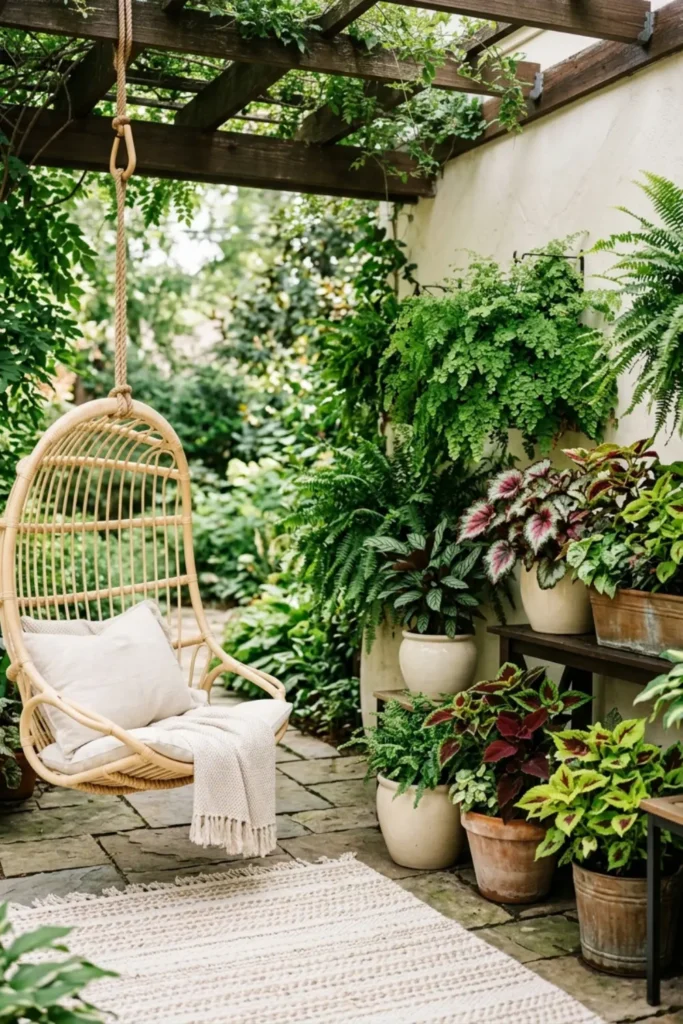
A shaded patio does not need to look empty.
The trick is to stop buying plants meant for full sun and focus on foliage shape, texture, and different greens.
Depending on climate, shade-friendly container options may include ferns, begonias, coleus, heuchera, hostas, and other plants sold for lower-light outdoor conditions.
University of Minnesota Extension notes that container gardening can work well in shade and recommends good drainage; see its gardening in the shade guide.
For the chair, choose a lighter color such as cream, natural rattan, warm taupe, or pale gray. Dark furniture in a deeply shaded corner can make the whole patio feel visually heavier.
Add color through one flowering pot rather than forcing bright flowers into every container.
12. Put an Outdoor Rug Under the Seating Zone
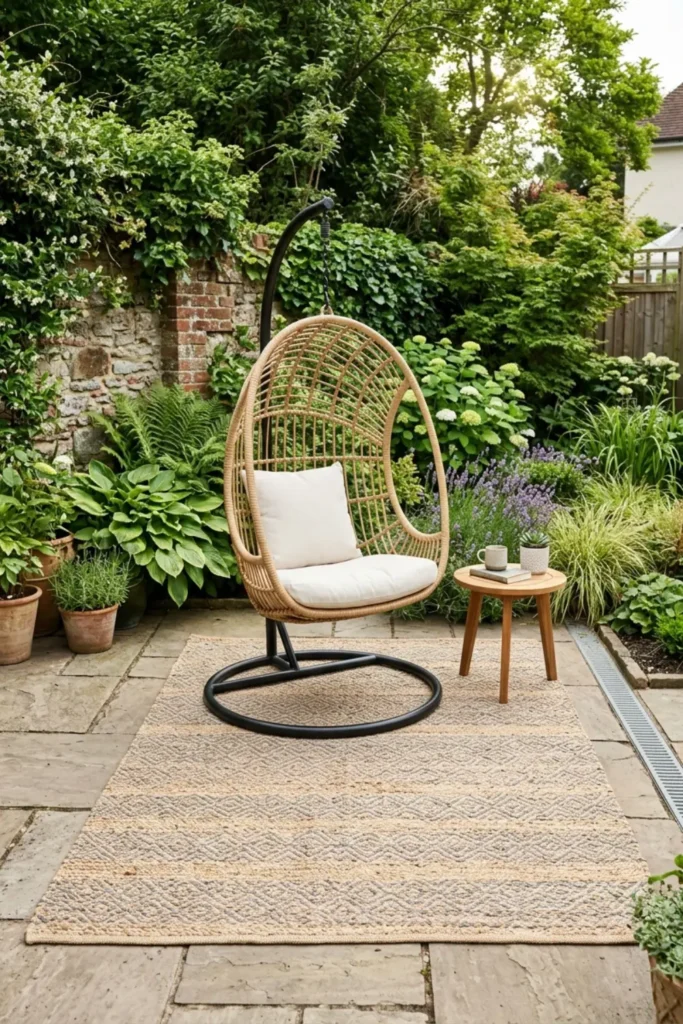
An outdoor rug can visually connect the hanging chair to the rest of the patio.
For a freestanding chair, choose a rug large enough that the stand sits fully and stably on the intended surface. Avoid a small rug that catches under part of the base or creates a raised edge in the walking path.
Measure before ordering. A 5 x 7-foot or 6 x 9-foot rug may suit many compact seating areas, but the correct size depends on the chair footprint and patio.
I prefer low-pile, outdoor-rated rugs around planters because soil and leaves are easier to clean.
Make sure water can drain and the rug can dry rather than staying wet underneath pots.
Do not use the rug to hide a damaged, uneven, or unsafe patio surface. Fix the walking surface first.
Planning cost: roughly $50–$250 for many outdoor rugs.
13. Group Terracotta Pots in Odd Numbers
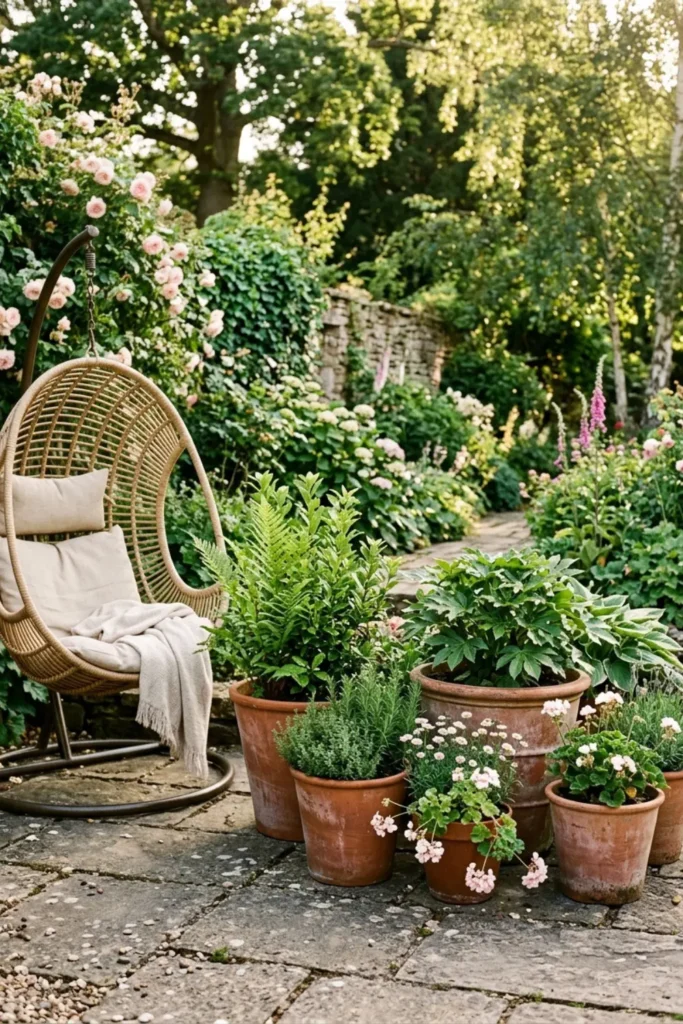
Terracotta looks especially good beside woven hanging chairs because both materials have warm, natural color.
Try a group of three or five pots in different heights instead of a long row of identical containers.
Keep the shapes related: perhaps one tall cylinder, one classic tapered pot, and one wide low bowl.
The plants can vary, but I would repeat at least one leaf color or flower color through the group.
Remember that unglazed terracotta can dry more quickly than some less porous containers, so do not assume every pot needs the same watering routine.
If the patio is exposed to freezing weather, check whether the specific pots are rated for those conditions and store or protect them as recommended.
14. Add Warm String Lights Around the Garden, Not the Chair
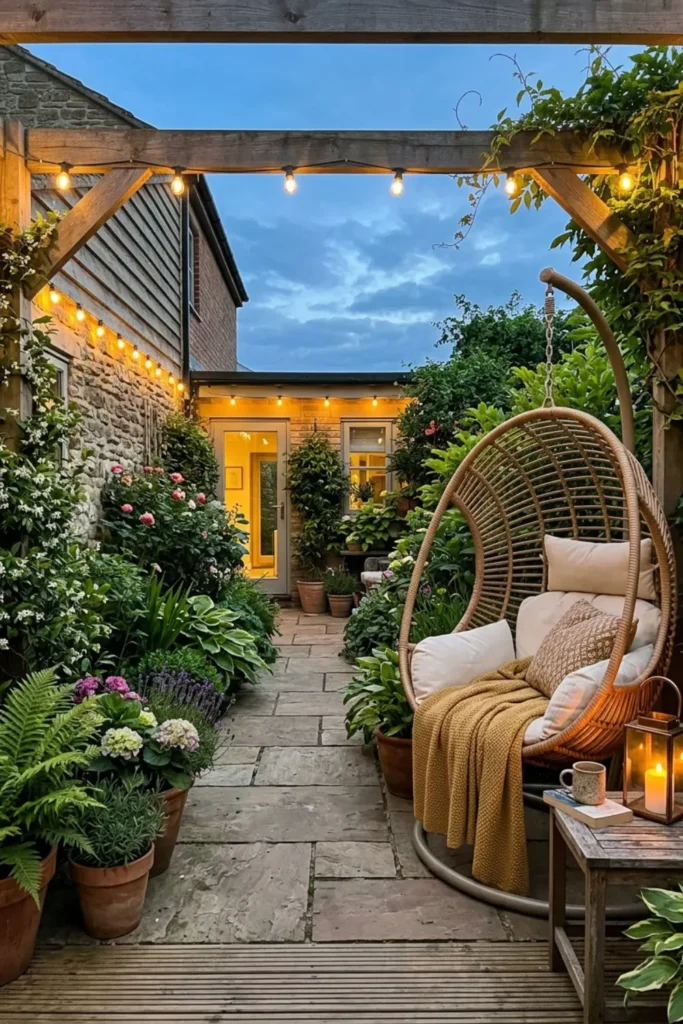
Lighting can make the patio useful after sunset, but it should frame the space rather than tangle with the chair.
Run outdoor-rated string lights around a pergola, fence, wall, or approved support, keeping them separate from the chair’s mounting hardware and movement area.
I prefer warm light rather than very cool white because it works better with greenery, terracotta, and woven furniture.
Do not overload the patio with five lighting styles. String lights plus one lantern or small table light is usually enough.
For plug-in outdoor lighting, use products rated for the intended outdoor conditions and follow electrical safety instructions. The Electrical Safety Foundation International advises that outdoor electric lights and decorations be used on GFCI-protected circuits and that damaged lights and cords be replaced; see its outdoor decoration safety guidance.
If permanent wiring is needed, use a qualified electrician.
15. Add a Small Side Table Without Blocking the Swing Zone
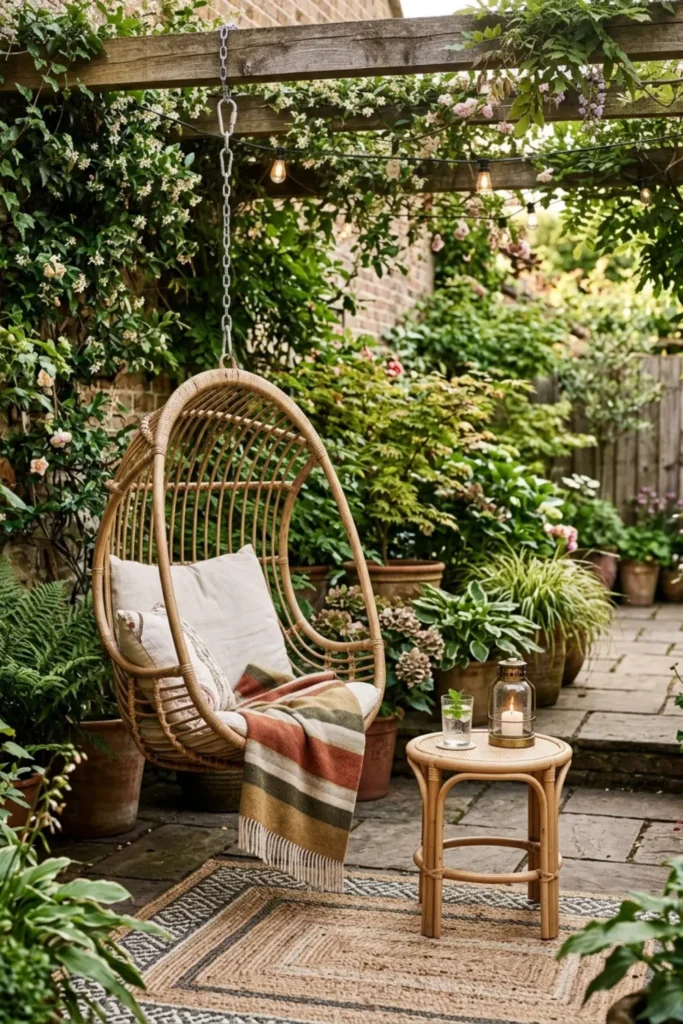
A hanging chair becomes much more useful when there is somewhere to place a drink, book, or phone.
The side table does not need to sit directly against the chair. Move it slightly forward or to the non-swinging side so the chair does not bump it.
A table around 16–20 inches across is often enough for a small patio, but check the chair and circulation first.
Choose a stable outdoor-rated material such as powder-coated metal, suitable wood, concrete-look composite, or weather-resistant resin.
Avoid a tall narrow table that can tip easily when someone reaches from a moving chair.
I would keep the top almost empty. One drink and a small lantern look better—and work better—than a permanent stack of decorative objects.
16. Use a Slim Water Feature Away From the Chair
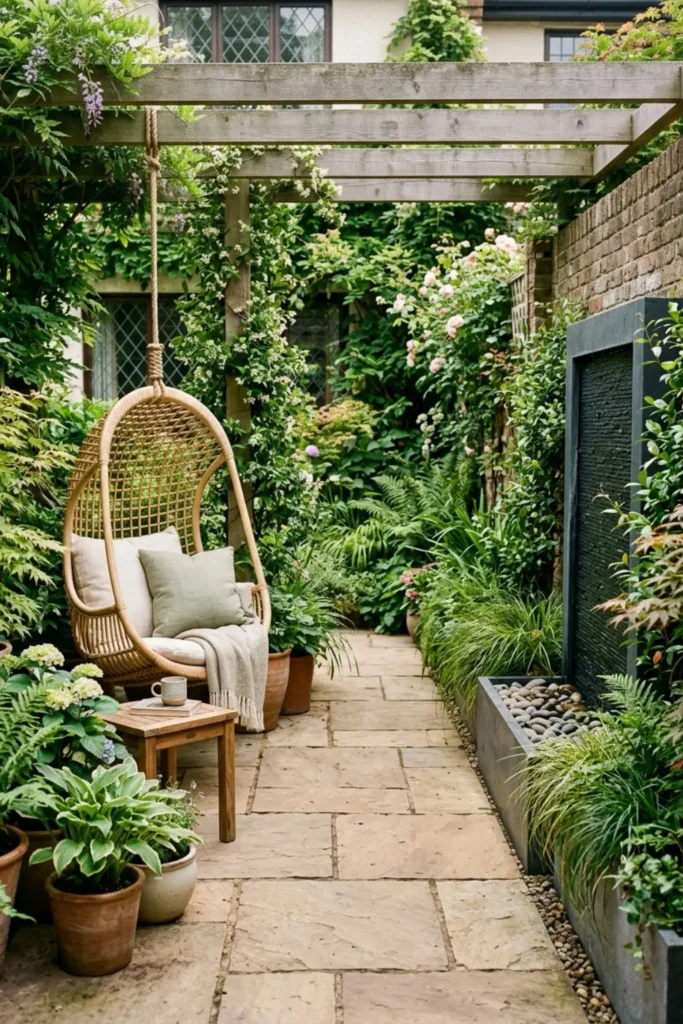
A small water feature can add sound to a patio garden without using much planting space.
Look for a compact recirculating fountain or wall-style feature that fits against a stable surface.
Keep electrical components, cords, and connections installed exactly as the manufacturer requires for outdoor use. Do not run extension cords through standing water or across the main walking path.
Place the fountain far enough from the hanging chair that normal movement cannot hit it or splash the seat.
I would also think about maintenance before buying. Outdoor water features collect leaves, dust, algae, and mineral deposits. A very detailed fountain may become another chore.
Sometimes a simple low bowl with moving water looks calmer than a large faux-stone feature.
17. Add One Narrow Raised Planter Along the Edge
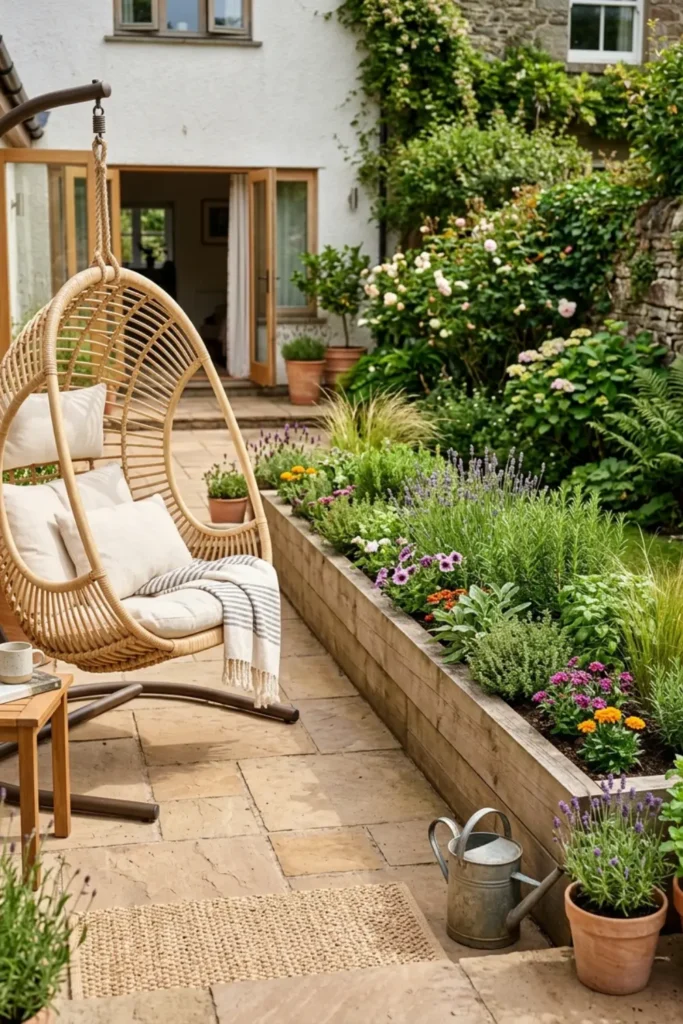
A raised planter can create a real garden bed feeling even when the patio itself is paved.
Use it along the outer edge rather than across the center of the space. This keeps the hanging chair area open while giving roots more soil volume than several tiny pots.
Choose a width you can comfortably reach across for watering, pruning, and harvesting. If you have to step into the planter to reach the back, it is probably too deep for the location.
Raised beds and containers can dry faster than surrounding ground, so build watering into the plan from the beginning.
For edible planting, use materials intended for that purpose and suitable potting or raised-bed media rather than filling the planter with random yard soil.
18. Change One Flower Color With the Season
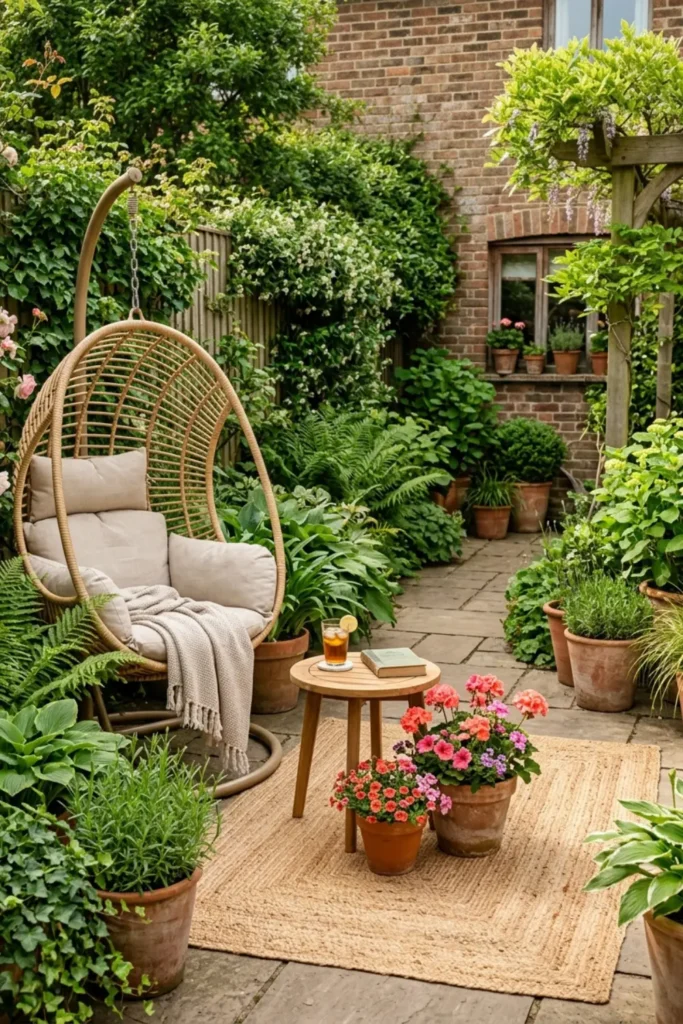
You do not need to redesign the patio every season.
Keep the hanging chair, largest green plants, rug, and main pots as the permanent structure. Then change one or two small containers with seasonal flowers.
For spring, that might be soft white and lavender. Summer could use coral or warm pink. Fall can shift toward rust, burgundy, and ornamental grasses.
The limited color change keeps the patio fresh without creating a pile of unused cushions and decorations in storage.
Choose flowers based on actual light and weather, not only the color on the nursery tag.
For perennials in the U.S., check your local conditions against the USDA Plant Hardiness Zone Map, but remember that hardiness zones mainly describe winter cold tolerance, not every growing condition.
19. Edit the Patio Until the Chair Has Room to Breathe
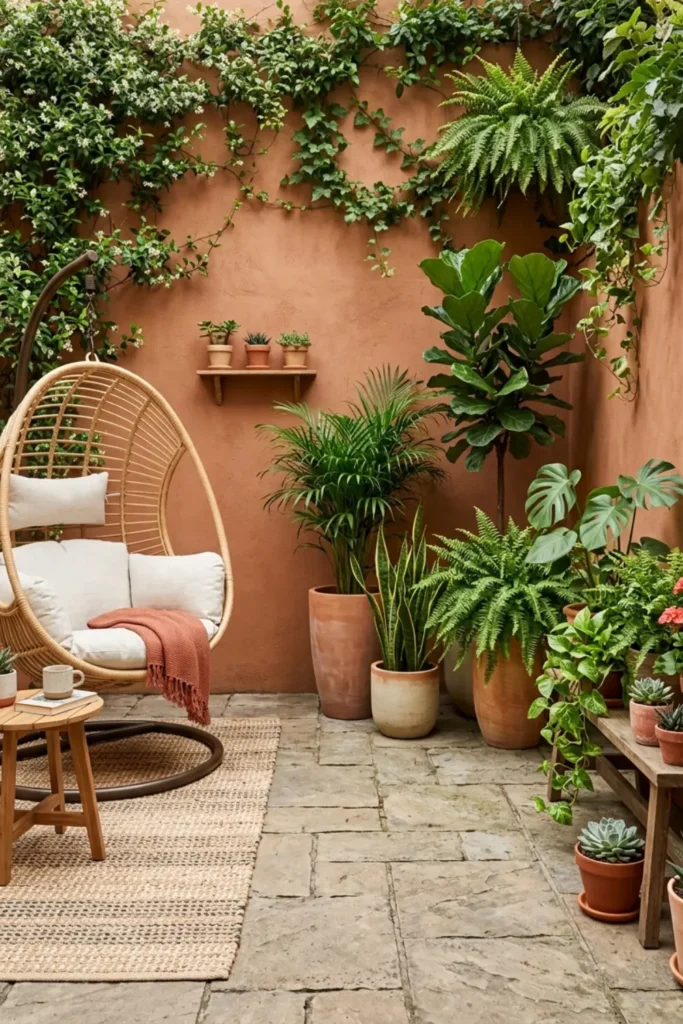
The last step is usually removing something.
Sit in the hanging chair and look around. Can you get in easily? Does the chair touch a plant? Can another person walk past? Can the patio door open fully? Is there a clear route for watering?
If the answer is no, move or remove a planter.
A garden does not become better because every square foot contains a plant.
For a small patio, I would keep one main chair, one clear path, one tall plant group, one lower plant group, and one useful surface. Add more only when the space still works.
Leave room for growth too. A patio arranged perfectly around newly purchased nursery plants can be crowded six weeks later.
The finished space should still feel comfortable on an ordinary day when there is a watering can on the floor, a few dropped leaves, and someone actually wants to sit down.
A Simple Shopping Order
If I were starting from an empty patio, I would buy things in this order:
- Measure the patio, door swing, and walking path.
- Choose the hanging chair and decide whether it will be freestanding or structurally mounted.
- Confirm installation requirements before buying overhead hardware.
- Add one or two large planters.
- Choose plants for the real light conditions.
- Add medium and low containers.
- Bring in a small side table.
- Add an outdoor rug only after the chair footprint is known.
- Finish with one lighting layer.
- Wait a few weeks before buying more plants.
That last step matters. Once plants begin to grow, the space often looks fuller than it did on planting day.
Where I Would Spend More
I would spend more on the hanging chair, secure installation where required, stable large planters, and plants that are actually suited to the site.
Those are the pieces that affect how the patio works.
I would spend less on tiny decorative pots, seasonal signs, outdoor pillows that cannot handle your weather, and multiple lighting accessories.
If the budget is tight, buy the chair first and use inexpensive nursery pots for a season. Once you understand which plants survive the light, heat, and watering routine, replace only the visible containers you want to keep long term.
Common Mistakes I Would Avoid
The first mistake is buying the chair without checking its full footprint or installation requirements.
The second is surrounding it with plants so tightly that the chair cannot move comfortably.
Another common problem is choosing plants by appearance without checking sun, shade, wind, drainage, or local climate.
Too many tiny pots are also harder to water and can make a small patio feel messy. A few larger containers usually create a stronger garden effect.
Finally, do not forget that outdoor spaces get wet. Use suitable outdoor products, keep electrical items protected as required, and do not let cords create a trip hazard through the seating area.
Final Thoughts
Patio garden ideas with a hanging chair work best when the chair and garden are planned together.
Start with the seat. Give it enough room to work. Then add plants in layers: tall greenery for shape, medium containers for fullness, and smaller herbs or flowers where you can actually reach them.
A rug, side table, or warm light can make the area feel finished, but none of those details should steal space from the chair or the plants.
I would rather have six healthy plants around one comfortable hanging chair than twenty struggling pots and nowhere to move.
That is the version of a patio garden that usually feels best after the photo is taken too: green, calm, useful, and easy enough to maintain that you still enjoy it a few months later.
Disclosure: Some visuals are AI-assisted design concepts created for inspiration. Always confirm measurements, materials, product weight limits, structural requirements, mounting hardware, electrical safety, drainage, weather exposure, plant toxicity, building or HOA rules, and installation requirements for your home. Costs are rough U.S. planning estimates and may vary by location, labor, materials, plants, delivery, and project conditions.
About the Author
Ali Hamza — Founder & Editor
Hi, I’m Ali Hamza, and Styled Room Living is my personal home decor project. I don’t have a formal background in interior design. I started this website because home makeovers are something I genuinely enjoy looking at and learning about. I can spend a surprising amount of time comparing layouts, storage ideas, colors, and small details that change how a space feels.
Most of the ideas shared here are not projects I have personally built. When I put a guide together, I try to separate an idea that only looks good in a photograph from one that could actually be useful in a normal home. Will it fit? Is it easy to clean? Does it require drilling? Can it be adjusted for a smaller budget? These are the questions I keep in mind while working on an article.
Some images on the website are AI-assisted design concepts used to explain an idea more clearly. They are meant for inspiration, not as exact construction plans. Please check measurements, materials, weight limits, prices, plant requirements, weather exposure, and installation requirements before trying anything in your own home.
I’m still learning as the website grows, and I know every home works differently. My purpose with Styled Room Living is simply to collect useful home ideas, explain them in plain language, and help readers find something they can adapt to their own space.
Read more about Ali Hamza →